

1. Why is “span” a key concept when building a factory?
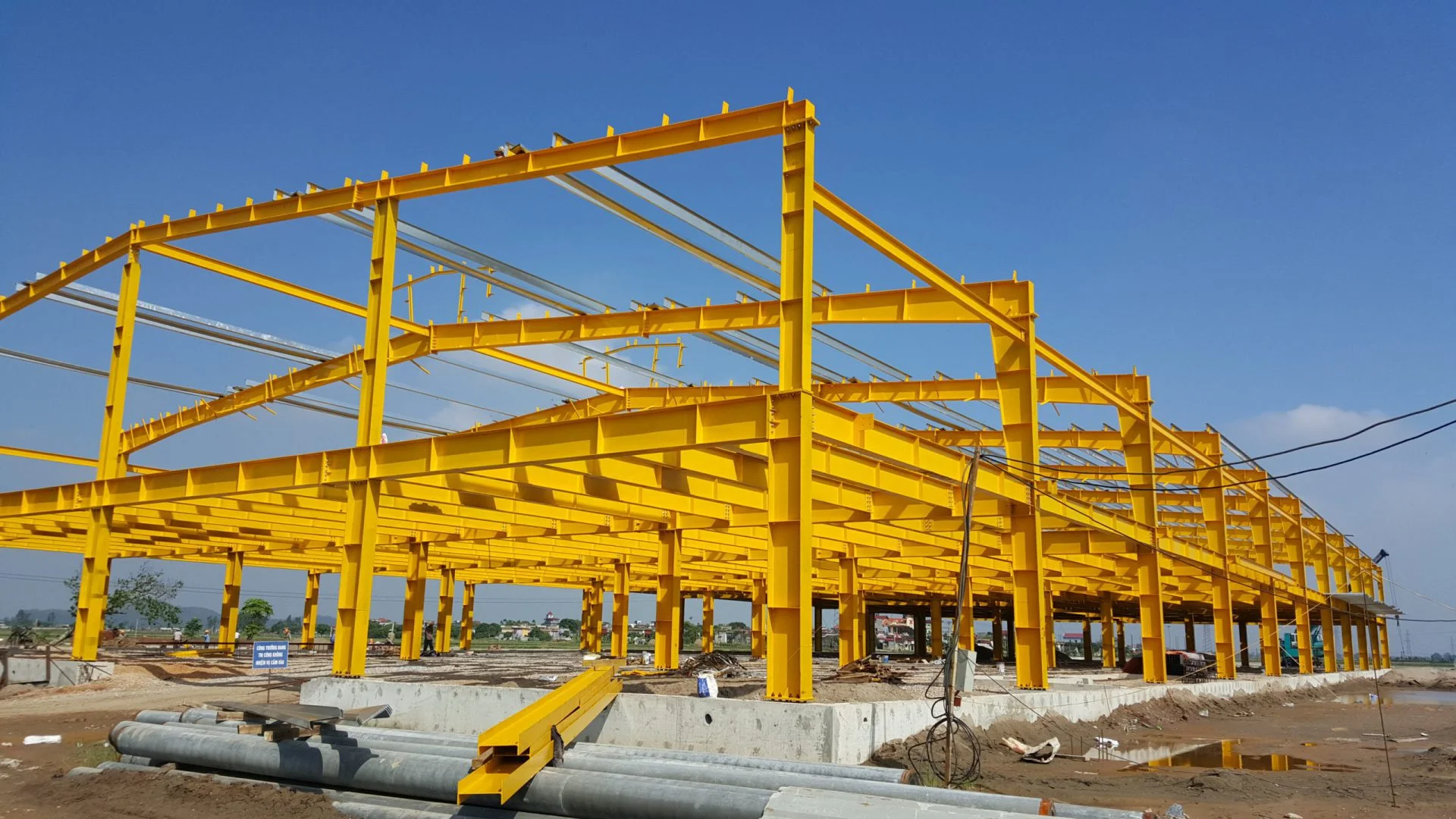
When starting to plan the construction of a factory, many investors often focus first on construction area, height, and schedule. However, in structural design, there is a concept that plays a decisive role but is often misunderstood, which is the factory span.
The span is not just a number representing the width of the building. In reality, the span directly affects the steel structure solution, the ability to arrange production lines, construction costs, and even the potential for future expansion. Determining the correct span from the beginning helps avoid many costly adjustments later on.

2. What is factory span?
Technically, the factory span is the clear distance between two main column rows of the factory, measured horizontally perpendicular to the length of the building. In other words, this is the main usable width of the factory.
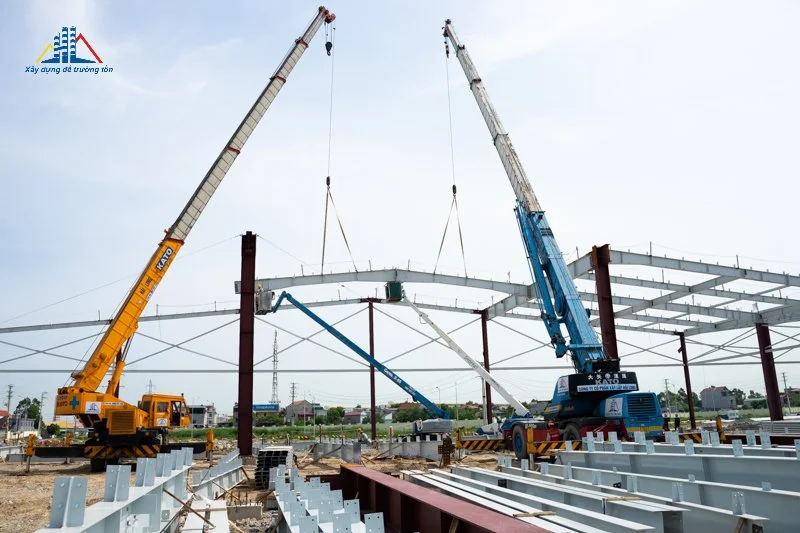
In steel structure factories, the span is usually the working span of the frame or roof truss. The larger the span, the higher the requirements for load-bearing capacity, stiffness, and stability of the structural system. Note: In some documents, the terms “span” and “clear span” may be used interchangeably. In the scope of this article, “span” is understood as the main width of the factory between two column systems.
3. Distinguishing between span, bay, and factory building width
In practice, these three concepts are often confused with one another.
Factory span: the distance between two main load-bearing column rows.
Bay: the working distance of a load-bearing component (beam, rafter, truss). In a single-span factory, the bay often coincides with the span.
Factory building width: a concept describing the total width of the structure, which may include roof overhangs or auxiliary spaces.
Clearly distinguishing these terms makes communication between the investor, design unit, and contractor more accurate and effective.
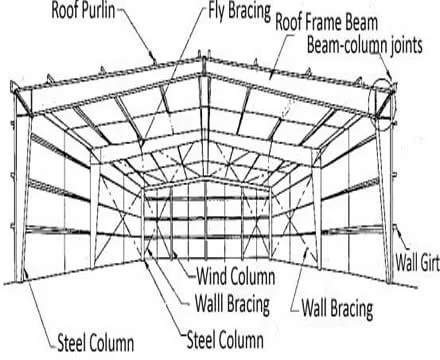
Small to medium span (approx. 12–20 m)
This is a quite common span range for medium-scale factories. At this level, rigid steel frame solutions usually perform well in terms of load-bearing capacity and economy.
Medium to large span (approx. 20–30 m)
With this span, requirements for stiffness and deflection control become important. The design must carefully consider the balance between rigid frames and cross-section optimization solutions.
Large span (over 30 m)
Large-span factories often serve specialized production or logistics. Structural solutions may shift to steel trusses or other optimized structural forms. Design and construction require more experience and careful calculation.
Note: The span milestones mentioned above are for reference only. The selection of a specific solution depends on load, height, cranes, and applicable standards.
4. Influence of span on steel structure solutions
Span is a factor that directly dictates the type of steel structure chosen for the factory.
As the span increases, the bending moment in the rafters/beams increases, leading to the need for larger cross-sections or changes in the load-bearing scheme. If the same solution is kept for a larger span, the structure may:
Experience excessive deflection
Vibrate under dynamic loads
Be inefficient in material usage
Conversely, choosing the right structural solution according to the span helps:
Optimize steel weight
Ensure stiffness and stability
Facilitate construction and erection
5. Span and factory operation challenges
Span is not just a structural issue; it is closely tied to how the factory is utilized.
Large-span factories allow for:
Flexible production line layout
Reduction of intermediate columns
Easy renovation or change of functionality
However, large spans also require:
More detailed structural design
Good control of vibration and deflection
Close coordination between design, fabrication, and erection
Therefore, the “ideal” span is not always the largest one, but the one most suitable for production needs and development orientation.
6. Common mistakes when determining factory span
In practice, some common mistakes include:
Determining span based on intuition rather than functionality
Focusing only on the present while ignoring expansion potential
Choosing a large span without investing properly in structural solutions
Confusing span with the total width of the building
These mistakes can lead to the need for structural reinforcement or costly renovations after the factory has gone into operation.
Factory span is a fundamental parameter in the design of steel structure factories. Understanding and reasonably determining the span helps in selecting appropriate structural solutions, ensuring investment efficiency, and facilitating long-term operation.
The span should not be decided in isolation, but rather considered simultaneously with the intended use, load, height, and development orientation of the factory building. This is a crucial step before delving into detailed design and construction.
HAI LONG CONSTRUCTION IS A REPUTABLE MANUFACTURER OF STEEL STRUCTURES
Choosing the right steel structure fabrication partner is the deciding factor for the success of every construction project. In a market that increasingly demands high quality, schedule adherence, and safety, Hai Long Steel Structure is proud to be a leading brand trusted by many major domestic and international investors:
- A team of experienced engineers, architects, and experts, knowledgeable in the design and construction of factory buildings and warehouses according to international standards.
- Diverse construction capabilities, meeting all project scales and requirements, from simple to complex factory buildings.
- Possessing a system of modern machinery and equipment, three steel structure factories with a capacity of nearly 45,000 tons/year ensure fast, accurate, and safe construction.
- Professional construction process, strictly managed.
Are you looking for a reputable and professional steel structure manufacturing and erection contractor? Contact Hai Long Construction for free consultation and quotation:
- HAI LONG CONSTRUCTION JSC – MEMBER OF TAIYO GROUP
- Address: Taiyo Building, 97 Bach Dang, Hong Bang Ward, Hai Phong City, Vietnam.
- Hotline: 084 6625 888
- Email: info@hailongjsc.vn