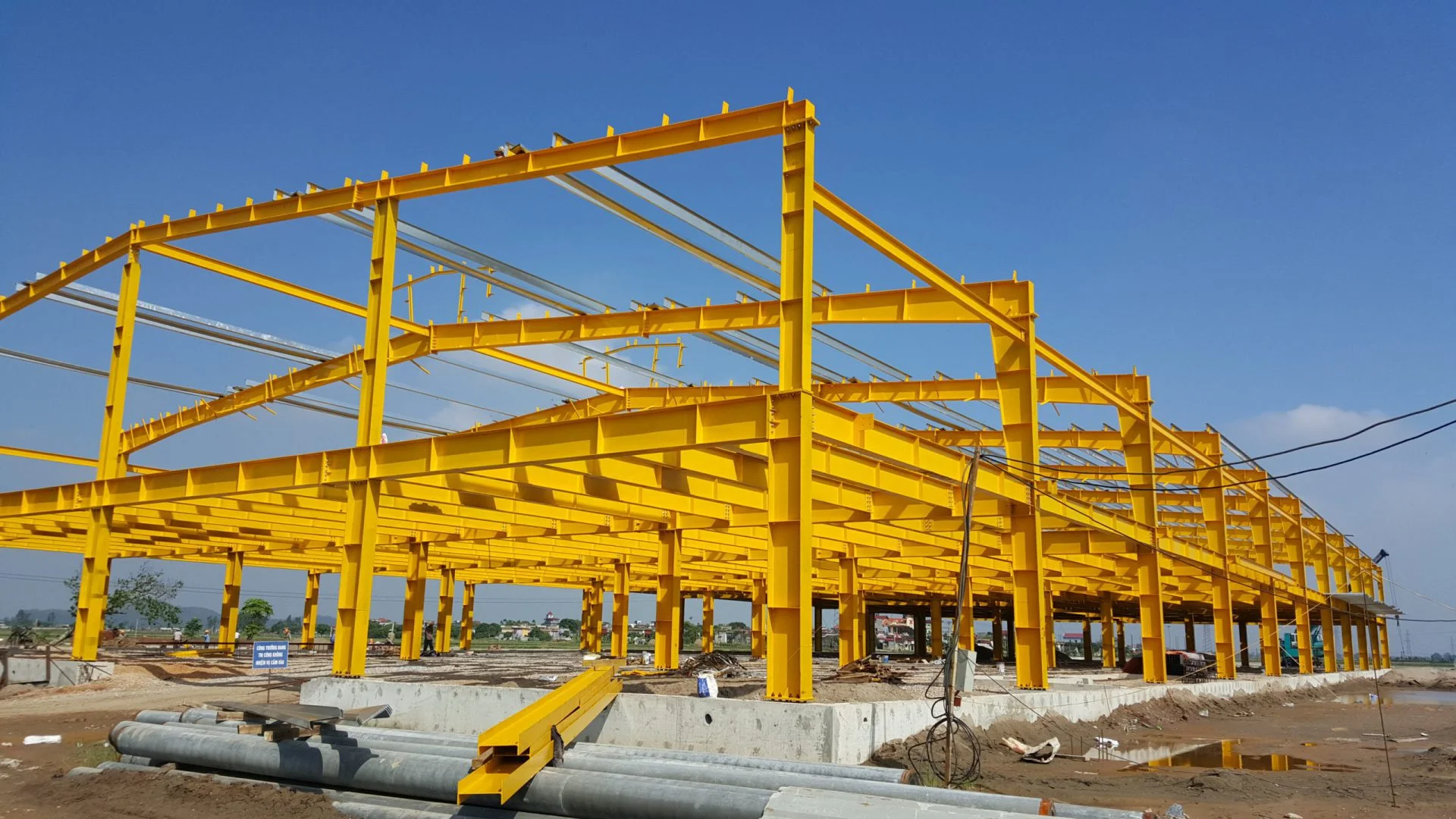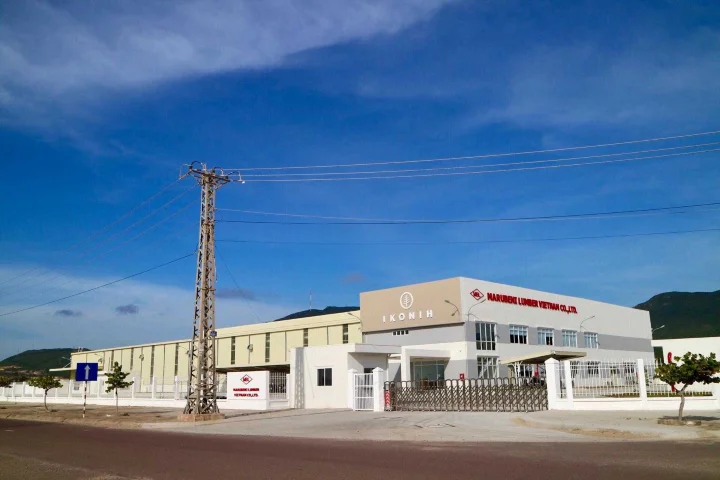


Steel structures are increasingly favored in industrial, commercial, and civil projects in Vietnam due to their advantages of fast construction, high durability, and flexible customization. However, the cost of steel structures is not a fixed figure – it fluctuates based on many factors and depends on the specific characteristics of each project.
According to industry surveys, the cost of the steel structure component typically accounts for 35% – 55% of the total value of an industrial factory building. Understanding the influencing factors helps investors control their budget from the design stage. This article will analyze each factor that constitutes steel structure costs, helping partners not only understand the numbers but also control them.
Example: Two factory buildings with the same area of 5,000m², but the steel structure costs differ by up to 35%. This is not because the contractor is "overcharging," but due to a series of technical decisions made (or overlooked) right from the design drawings.
OVERVIEW OF STEEL STRUCTURE PROJECT COSTS
Before analyzing each factor, it is necessary to understand that steel structure costs are not just the price of purchasing steel. The entire value chain from raw materials to finished components at the construction site includes many layers of accumulated costs such as:
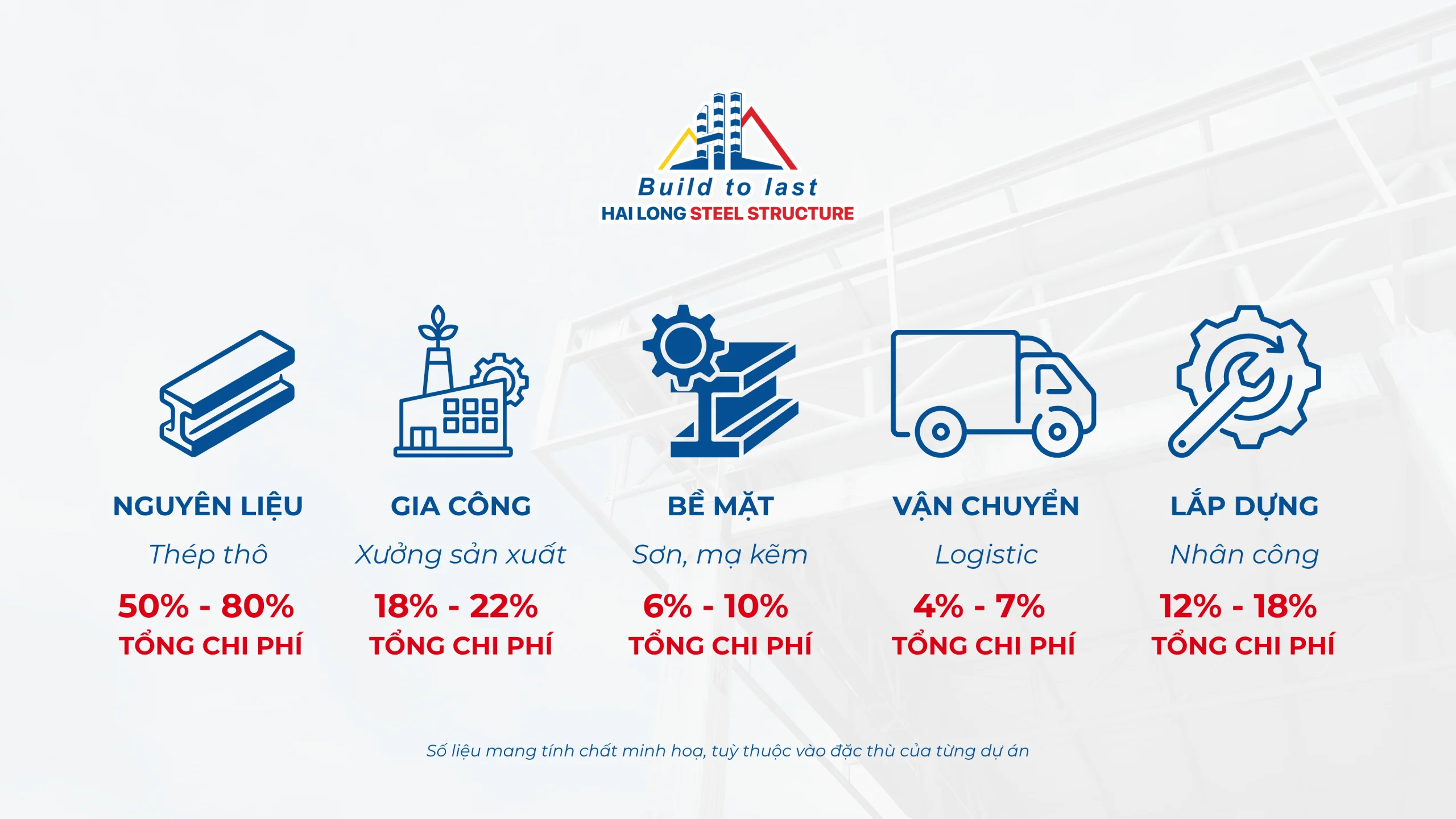
The fluctuation rate depends on the scale, location, and complexity. Factories in remote areas will have higher logistics costs; projects with many complex details will increase fabrication costs. By understanding this structure, investors will know exactly which stage to influence to reduce total costs most effectively.
8 MAIN FACTORS AFFECTING STEEL STRUCTURE COSTS
1. Raw steel prices and price formation mechanisms
Construction steel is a commodity traded on the international market, and its price is simultaneously affected by many variables:
- Iron ore and steel billet prices: Steel billet is the basic raw material for producing hot-rolled steel. (Example: When the price of iron ore at Qingdao port (China) increases by 10 USD/ton, domestic steel billet prices usually react within 2-4 weeks.)
- Import tax policies: Vietnam has applied anti-dumping duties on hot-rolled steel originating from China since March 8, 2025, with tax rates ranging from 19.38% to 27.83% (Source: Thu Vien Phap Luat), directly impacting domestic market prices.
- USD/VND exchange rate: With ~40–50% of steel used domestically being imported, a 1% fluctuation in the exchange rate can immediately change steel prices by 0.4–0.5%.
- Energy prices: Electricity and coking coal costs account for 25–30% of steel production costs — energy price fluctuations after 2022 have significantly increased global steel production costs.
Reality: In 2021, the price of construction steel in Vietnam increased from 13,000 to 19,000/kg within 6 months — equivalent to +50%. Projects that signed fixed-price contracts were significantly affected. This is why large-scale steel structure contracts today often include clauses for price adjustments based on the material industry CPI.
2. Selection of steel type and technical standards
Each type of steel has different prices and applications. H, I, C, V-shaped steel, etc., are suitable for different load-bearing positions. Choosing the right type of steel according to TCVN, JIS, or ASTM standards not only ensures safety but also avoids wasting resources.
Example: Important technique: When using high-strength steel (A572 Gr.50 instead of SS400), the same cross-section can withstand ~45% higher loads. This allows for reducing the cross-section size, saving 15–25% of steel weight — enough to offset the higher price and often resulting in a lower total cost for large-span or heavy-load projects.
3. Structural scheme, span, and building height
This is the technical factor with the greatest impact that few investors pay enough attention to — because it is decided at the preliminary design stage, before detailed calculations.
- Structural span: The weight of the main beam increases almost quadratically with the span. Increasing the span from 18m to 24m (+33%) can increase the amount of main beam steel by 60–80%.
- Column spacing: 6m vs 9m column spacing affects the number of columns, longitudinal beams, and bracing systems. Larger column spacing reduces the number of columns but increases beam size — optimization needs to be calculated for each specific project.
- Column height: An 8m high column compared to a 6m one not only increases the amount of column steel but also increases horizontal force due to wind, requiring larger roof and vertical bracing — a chain reaction throughout the entire structural system.
- Roof system: Flat single-span roof, sawtooth roof, double-pitched roof — each type has a different steel weight/m² of floor area coefficient ranging from 25–60 kg/m².
Calculation example:
Factory 5,000m² (100x50m), horizontal span 25m, column spacing 5m → main structural steel amount is about 45–55 kg/m².
If the span is increased to 30m, with the same area → the steel amount can reach 60–70 kg/m².
A difference of 15 kg/m² × 5,000m² × 22,000 VND/kg = 1.65 billion VND just for steel costs — excluding fabrication and erection.
4. Design loads and special requirements
Steel structures are designed according to load combinations — every additional load requirement leads to an increase in structural cross-sections:
- Wind load: Hai Phong belongs to wind zone II-B according to TCVN 2737, with a calculated wind pressure of ~0.83 kN/m². Projects in the same coastal area (Quang Ninh, Da Nang) may belong to zone III–IV, where wind loads increase by 30–50%, leading to a significant increase in bracing system costs.
- Overhead crane: A 5-ton crane requires a separate runway beam and dynamic load-bearing columns, increasing the total amount of structural steel by 15–25% compared to a factory without a crane of the same area. A 20-ton crane can increase it by 40–60%.
- Roof load: Sandwich panels, single-layer metal roofing, or tile roofing — roof weights vary from 5–80 kg/m², affecting the entire roof support structure system.
- Seismic load: In the Hanoi area and Northern mountainous provinces, where MSK ≥ VI, seismic design is required according to TCVN 9386, which may increase the amount of connection steel by 10–20%.
5. Transportation and on-site erection costs
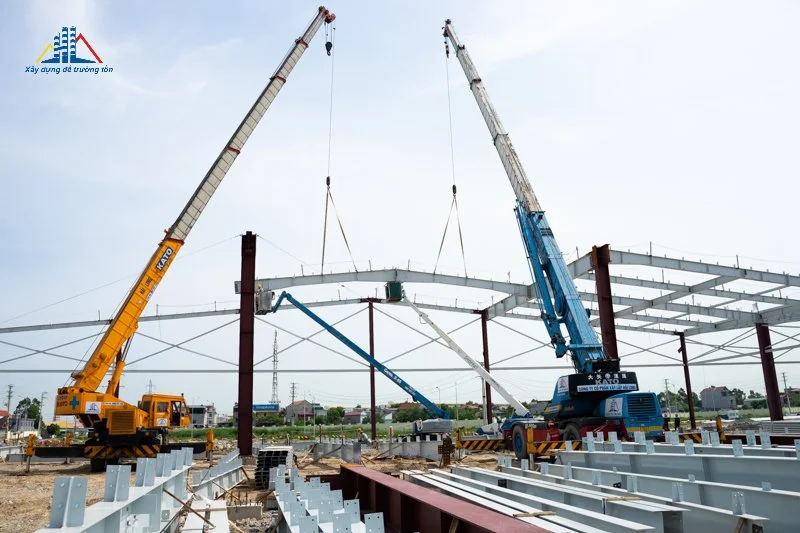
The distance from the fabrication workshop to the construction site, road conditions, and specialized transport vehicles all generate significant additional costs. Erection costs (labor + crane equipment) typically account for 15–25% of the total steel structure cost.
Technical factors affecting the unit price of fabrication:
- Number of section types: A workshop processing an order using 3 types of sections will be cheaper than one using 15 types, due to reduced machine setup time.
- Weld density: Welding costs typically account for 40–50% of fabrication costs. Structures with many short welds are more expensive than those with fewer long, uniform welds.
- Non-Destructive Testing (NDT) requirements: Welds requiring UT (ultrasonic) or RT (radiographic) testing increase inspection costs by 0.5–2% of the total value, but are mandatory for critical structures.
- Erection tolerances: Requirements for ±2mm tolerances (as in electronics or pharmaceutical factories) demand CNC fabrication equipment and more quality control time compared to standard factory buildings (±5mm).
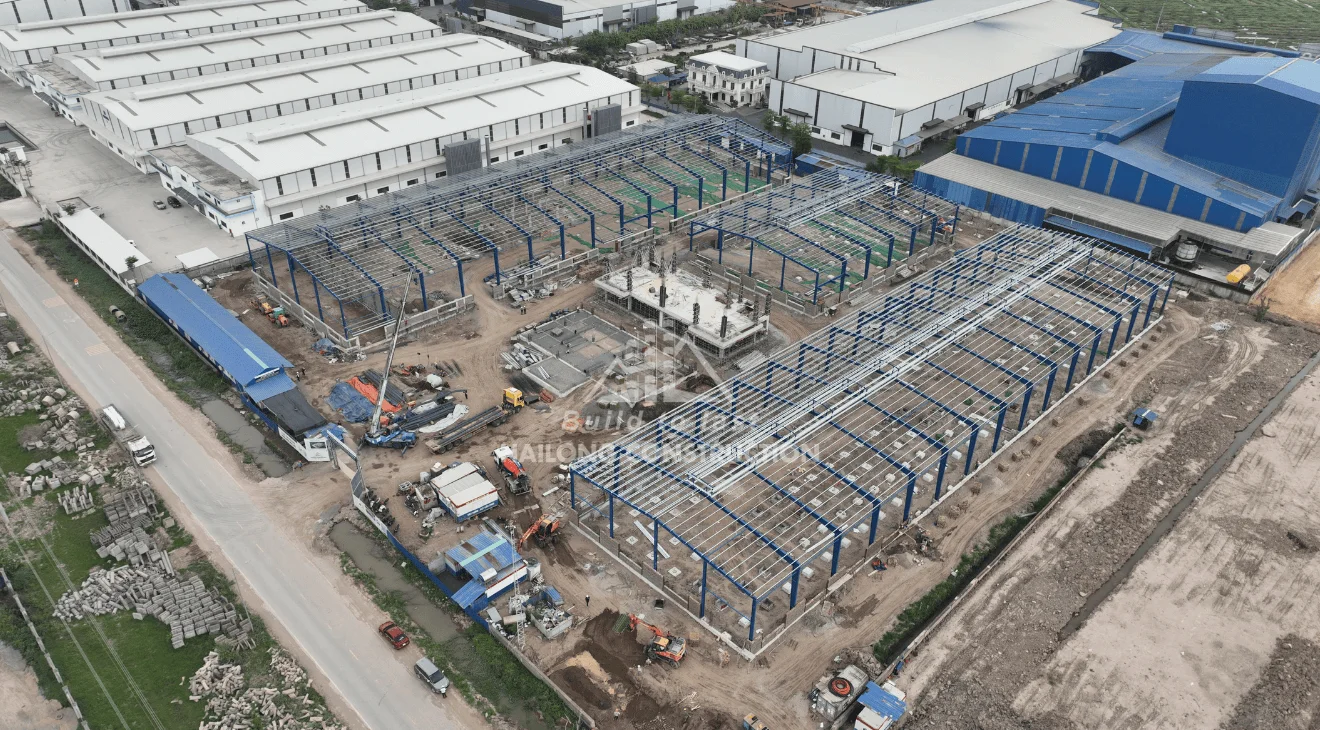
6. Corrosion protection system and surface treatment
Carbon steel oxidizes in humid conditions. The surface protection system is not just an initial cost but determines the lifespan and long-term maintenance costs — the TCO (Total Cost of Ownership) concept is very important here.
Special note for Hai Phong and coastal areas: The salinity of the air in seaport areas can be 5–10 times higher than inland. According to ISO 9223 standards, the Hai Phong environment belongs to the C4–C5 category (high–very high corrosivity), requiring at least a 3-layer paint system or HDG. Saving 50 million on initial painting costs can lead to maintenance costs of 200–500 million after 5–8 years.
7. Transportation, logistics, and site conditions
Logistics costs are often underestimated during the initial estimation phase but arise significantly during actual implementation:
- Transportation distance: The cost of specialized vehicles carrying long components (12m columns, 18m beams) from Hai Phong to Hanoi (~100km) is about 3–5 million/trip. Going to Nghe An (~320km) is 3–4 times higher. Oversized components (length >12m, width >2.5m) require special transport permits, increasing costs and time.
- Erection crane equipment: 25–50 ton cranes for standard factory buildings; 100–300 ton cranes are needed for heavy components or large spans — crane rental costs increase exponentially.
- Site conditions: Projects in industrial parks with wide access roads vs. inner-city projects with narrow alleys — erection costs can differ by 20–40%.
- Erection sequence and schedule: Night shift erection, requirements for complex safety barriers, or having to work in phases to avoid affecting existing production all increase costs.
8. Contract methods, project management, and implementation timing
These "soft" factors are often overlooked but can create a 10–20% difference in actual costs compared to the initial estimate:
- Timing of steel procurement in the market cycle: Steel prices have clear cyclical fluctuations. Projects ordering steel when prices are at their peak will incur costs 15–30% higher than ordering at the bottom of the cycle.
- Contract type: Lump sum contracts force contractors to include risk costs in the price — usually 5–10% higher than unit price contracts. However, conversely, lump sum contracts protect the investor from cost overruns.
- Detailed design capability: Poor quality design drawings lead to quantity overruns during construction — in reality, 15–25% of projects have steel quantity overruns > 10% due to incomplete design drawings.
- Schedule and deadline pressure: Requirements to shorten the schedule by 30% often lead to a 15–25% increase in costs due to overtime, parallel equipment rental, and reduced construction efficiency.
FREQUENTLY ASKED QUESTIONS ABOUT STEEL STRUCTURE COSTS
What is the average amount of structural steel for 1m² of factory building?
Ranges from 25 to 70 kg/m² depending on the type of project. Light factory buildings without cranes, span ≤ 18m: 25–40 kg/m². Factory buildings with heavy cranes, large spans: 50–70 kg/m². Multi-story steel-framed office buildings: 35–55 kg/m² of floor area.
Should steel structure fabrication be ordered by ton or by m²?
Signing a contract based on finished weight is the industry standard, as it accurately reflects the volume of fabrication work. Contracts based on floor m² are prone to disputes when the actual amount of steel differs from the design. Always request design drawings and a detailed material take-off before signing a contract.
How much % of the total investment does steel structure design cost account for?
The cost of technical design and shop drawing design typically accounts for 1.5–3.5% of the steel structure value. This is the investment with the highest ROI — good design saves 10–20% in material costs, which is 5–10 times the design fee.
HAI LONG STEEL STRUCTURE IS A REPUTABLE STEEL STRUCTURE MANUFACTURER
Choosing the right steel structure fabrication partner is the deciding factor for the success of every construction project.
In a market context that increasingly demands high quality, schedule, and safety, Hai Long Steel Structure is proud to be a leading brand trusted by many major domestic and international investors:
- A team of experienced engineers, architects, and experts, knowledgeable in the design and construction of factory buildings and warehouses according to international standards.
- Diverse construction capabilities, meeting all project scales and requirements, from simple to complex factory buildings.
- Owning a steel structure factory with modern machinery and equipment systems, ensuring fast, accurate, and safe construction.
- Professional construction process, strictly managed.
Are you looking for a reputable and professional steel structure manufacturing and erection contractor?
Contact Hai Long Construction for free consultation and quotation:
- HAI LONG CONSTRUCTION JSC
- Address: Taiyo Building, 97 Bach Dang, Hong Bang Ward, Hai Phong City, Vietnam.
- Hotline: 084 6625 888
- Email: info@hailongjsc.vn