

Structure of bolts in steel structures
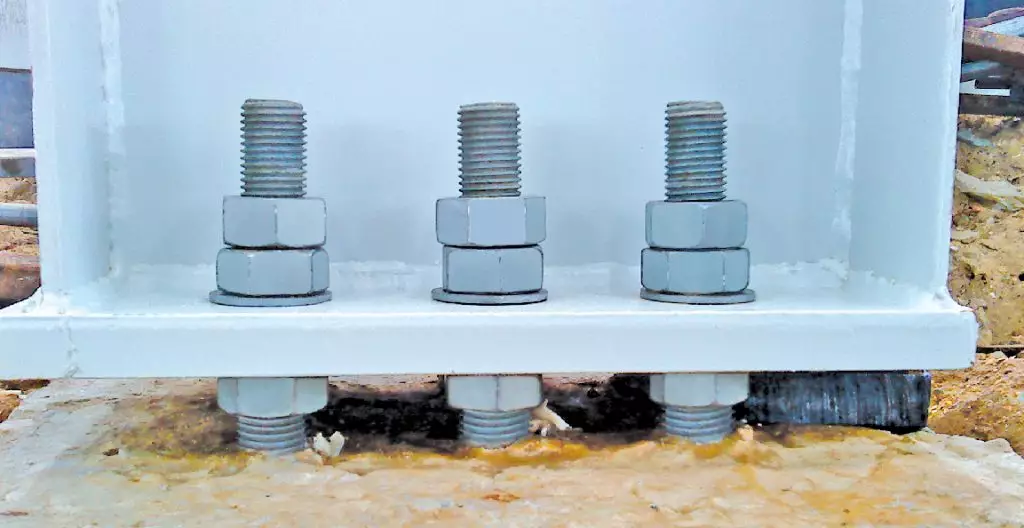
Bolts in steel structures have four main components, including the bolt shank, bolt head, nut, and washer. Each component plays an important role in creating a secure connection between steel parts, and these components can be manufactured in various sizes to suit the specific requirements of the project.
1.1. Bolt shank
The bolt shank is the most important part of the bolt, usually having a circular cross-section and manufactured from steel. The diameter of the bolt shank (denoted as: d) ranges from 12 to 48 mm, with the most common bolt diameters being between 20 and 30 mm.
- Internal thread diameter (denoted as: do) is the diameter of the threaded part inside the bolt shank, and according to the formula, do = 0.85d. This means the diameter of the threaded part will be slightly smaller than the overall diameter of the bolt shank.
- For partially threaded bolts (according to DIN 931 standard), the length of the threaded part is usually denoted as lo, with the formula for the threaded length being lo ≈ 2.5d. For this type of bolt, the length of the unthreaded part must be 2-3 mm less than the thickness of the steel plate when performing a through-bolt connection.
- For fully threaded bolts (according to DIN 933 standard), the thread length is the length of the bolt, denoted as l. This type of bolt has a common length ranging from 35 to 300 mm.
The structure and precise dimensions of the bolt shank are very important as they affect the load-bearing capacity and durability of the steel structure during assembly.
1.2. Bolt Head
The bolt head is usually manufactured in a hexagonal shape with beveled corners for easy handling during assembly. The main parameters of the bolt head include:
- Circumscribed circle diameter of the bolt head, denoted as D, is calculated by the formula D = 1.7d. This means the diameter of the bolt head is 1.7 times larger than the bolt shank diameter (d).
- Bolt head thickness, denoted as h, is calculated by the formula h = 0.6d. This means the thickness of the bolt head is 60% of the bolt shank diameter.
- Inscribed circle diameter of the bolt head, denoted as S, is a common dimension in bolt heads with even numbers, for example, S = 12, 14, 16, 18,….
1.3. Nut
The nut, like the bolt head, is usually hexagonal in shape and is drilled and threaded so that the thread pitch of the nut and the bolt shank are the same. Important parameters of the nut include:
- Nut thickness, denoted as h, has the condition h ≥ 0.6d, meaning the thickness of the nut must be greater than or equal to 60% of the bolt shank diameter.
1.4. Washer
The washer is manufactured in a circular shape and functions to distribute the pressure of the nut evenly onto the surface of the base steel structure. The dimensions of the washer, including parameters D, do, lo, and h, are specified based on the diameter of the bolt shank (d). As the diameter d increases, the above dimensions of the washer must also be larger.
The components of a steel structure bolt, including the bolt shank, bolt head, nut, and washer, all have specific dimensions and proportions, helping them function effectively in creating a secure connection between parts of the steel structure. The selection and arrangement of these components must comply with technical standards to ensure the safety and stability of the project.
2. Types of Bolts in Steel Structure
2.1. Rough Bolts, Ordinary Bolts
Rough bolts and ordinary bolts are made from carbon steel through forging and stamping methods. The main characteristic of this type of bolt is that the bolt shank diameter is 2-3 mm smaller than the hole in the steel plate, thus having low precision. The production process is fast and the cost is low, but the quality is not high. Therefore, when using these bolts, the contact between the bolt and the hole is not tight, leading to high deformation during operation, especially when subjected to shear forces.
Application: Rough bolts and ordinary bolts are suitable for positioning components during assembly or in cases where they are mainly subjected to tension, not excessive loads.
2.2. Precision Bolts
Precision bolts are manufactured from carbon steel or low-alloy steel using turning methods, ensuring high precision. The diameter of these bolts does not differ by more than 0.3 mm from the hole. There are two types of precision bolts: one installed in a hole without clearance and one installed in a hole with clearance. The type of precision bolt without clearance helps create a secure connection, has high load-bearing capacity, and minimal initial deformation.
Application: Precision bolts are used in projects requiring high precision and good load-bearing capacity.
2.3. High-Strength Bolts
High-strength bolts are manufactured from alloy steel and undergo a heat treatment process to enhance tensile strength and tightening capability. These bolts can create significant friction between steel plates, helping to transfer force from one component to another primarily through friction. High-strength bolts have excellent load-bearing capacity, high durability, and minimal deformation.
Application: This type of bolt is very common in heavy-load structures, especially in projects requiring high mechanical durability such as steel structures subjected to dynamic or static loads.
These types of bolts all have distinct characteristics and applications, depending on the technical requirements and load of the project. Rough bolts are suitable for simple assembly work, while precision bolts and high-strength bolts are suitable for projects requiring high precision and strong load-bearing capacity.
3. Methods of Arranging Bolts in Steel Structure
The arrangement of bolts in a steel structure must ensure reasonable spacing to both save material and ensure the durability of the connection. Arranging bolts too close together can make the steel plate prone to tearing, while placing them too far apart will make the connection loose and increase costs. Therefore, reasonable calculation of the distance between bolts is necessary to ensure the load-bearing capacity and stability of the structure.
There are three main ways to arrange bolts in a steel structure:
- Parallel arrangement
Bolts are arranged parallel to each other in straight rows. This method is often used in structures that require uniform load-bearing capacity over a large area. - Staggered arrangement
Bolts are arranged in a cross or staggered pattern between rows, helping to increase more uniform force distribution and reduce the risk of connection failure under load. - Bolt arrangement for structural steel shapes
The arrangement of bolts in structural steel shapes will depend on the dimensions of each type of steel shape. Specifically, for angle steel:- If the width (denoted as b) of the angle steel is less than 100 mm, only 1 row of bolts is needed.
- If the width of the angle steel is greater than 100 mm, 2 rows of bolts will be needed to ensure the stability of the connection.
Above is the information regarding bolted connections in steel structures, including their structure and types of bolts. Are you looking for a reputable and professional steel structure manufacturer and erector? Please contact Hai Long Construction for free consultation and quotation:
- HAI LONG CONSTRUCTION JSC – MEMBER OF TAIYO GROUP
- Address: Taiyo Building, 97 Bach Dang, Ha Ly Ward, Hong Bang District, Hai Phong City, Vietnam.
- Hotline: 084 6625 888
- Email: info@hailongjsc.vn