

In the industrial construction industry, steel structure is likened to the “skeleton” supporting the entire project. The sturdiness, safety, and lifespan of a project depend directly on the quality of each steel component. Therefore, applying technical standards is not only a legal requirement but also the highest commitment to quality and safety. In Vietnam, the National Standard (TCVN) system acts as the foundational technical framework, mandatory for all construction projects, ensuring uniformity and safety.
For investors and project engineers, understanding these standards is a “vital” factor to control quality and evaluate the contractor's capacity. A reputable steel structure manufacturer must demonstrate the ability to strictly and comprehensively comply with the TCVN system throughout the product lifecycle. This article will provide an analytical perspective, systematizing the core TCVNs related to the process from design, material selection, processing, welding, surface protection to erection and acceptance of steel structures.
TCVN 5575:2012 (and 2024 update)
TCVN 5575, with the latest versions being TCVN 5575:2012 and the updated TCVN 5575:2024, is considered the core standard in the field of steel structure design for civil and industrial works. This standard does not apply to specialized works such as transportation or irrigation. The content of TCVN 5575 sets out basic principles and requirements, shaping the entire subsequent production and erection process.
Core design principles
The most basic and important principle that TCVN 5575 puts forward is the method of calculating structures according to limit states, meaning that the structure is designed so as not to exceed the states that could cause it to lose its normal working capacity. There are two main groups of limit states:
- Ultimate limit state (First limit state): These are states related to the safety of the work, when the structure can be destroyed or collapsed. Cases include failure in strength, loss of overall or local stability, brittle fracture, or yielding of materials.
- Serviceability limit state (Second limit state): These are states that affect the normal operation and exploitation of the work, such as the structure having excessive deflection or deformation, causing excessive vibration, or damaging architectural parts and equipment.
To ensure safety, the standard requires that when calculating, reliability coefficients must be used, including load coefficients (according to TCVN 2737), material coefficients, and working condition coefficients. Internal forces must be calculated with the most unfavorable combination of loads that can occur.
Requirements for connection materials
TCVN 5575:2012 does not exist independently but forms a tightly linked network with a series of different standards regarding materials and test methods, requiring manufacturers to have a quality management system strong enough to control synchronously.
- Steel materials: Steel grade and applicable standards must be clearly stated on the design drawings. The standard also encourages prioritizing the use of steel produced in Vietnam.
- Welding materials: Welding rods and welding wires must comply with standards such as TCVN 3223:2000 and TCVN 3909:2000, ensuring compatibility with the base material and creating welds with the required mechanical properties.
- Bolts: Bolts used in steel structures must comply with TCVN 1916:1995, with a minimum strength grade of 4.6
The citation of these details shows the systematic and complex nature of compliance. A professional manufacturer not only applies TCVN 5575 but also must manage and control the input quality of a series of materials according to related standards.
Processing, Erection, and Acceptance Process according to TCVN 170:2007 (and TCVN 13194)
If TCVN 5575 is the guiding principle for design, then the TCXD 170:2007 standard set (now replaced and updated by parts of TCVN 170:2022 and TCVN 13194) is the regulation for the process of “realizing” the drawings, from the factory to the construction site.
Factory Fabrication
The quality of structural components is determined right from the initial stages at the factory.
- Material Preparation: 100% of steel plates and sections must be inspected, straightened, and cleaned of rust, grease, and impurities before fabrication. Classification, labeling, and color-coding for each steel grade are mandatory to avoid confusion.
- Cutting and Forming: Cutting lines must ensure precision in dimensions and geometry according to the tolerances allowed in the design.
- Component Assembly: After cutting, parts are assembled into complete components. This process requires high precision to ensure that joints and connections fit perfectly during on-site erection.
On-site Erection
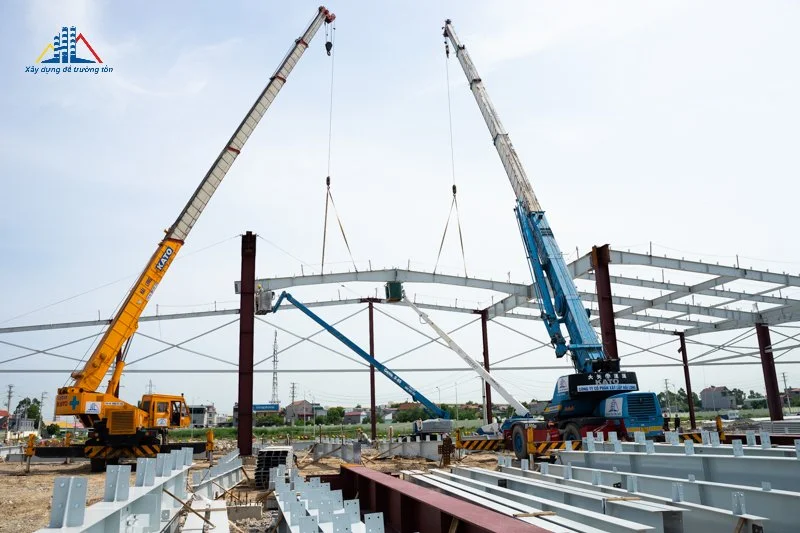
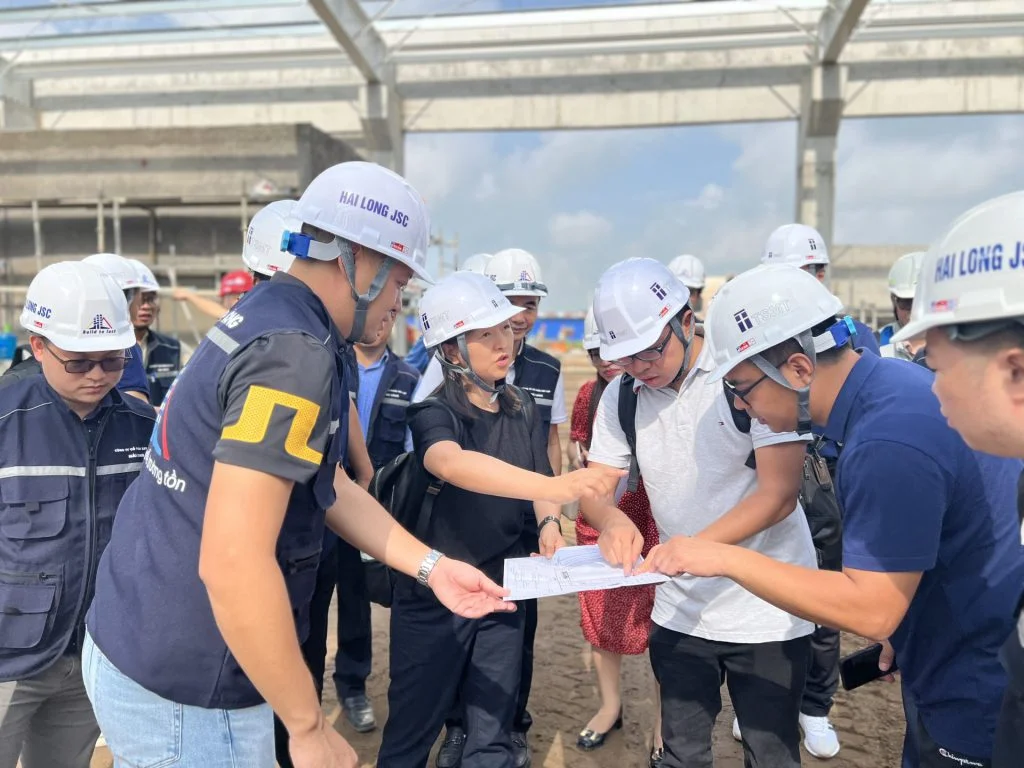
- Foundation Inspection: Before erection, the position and elevation of anchor bolts embedded in the concrete foundation must be inspected and accepted. Errors at this stage will affect the entire steel frame later.
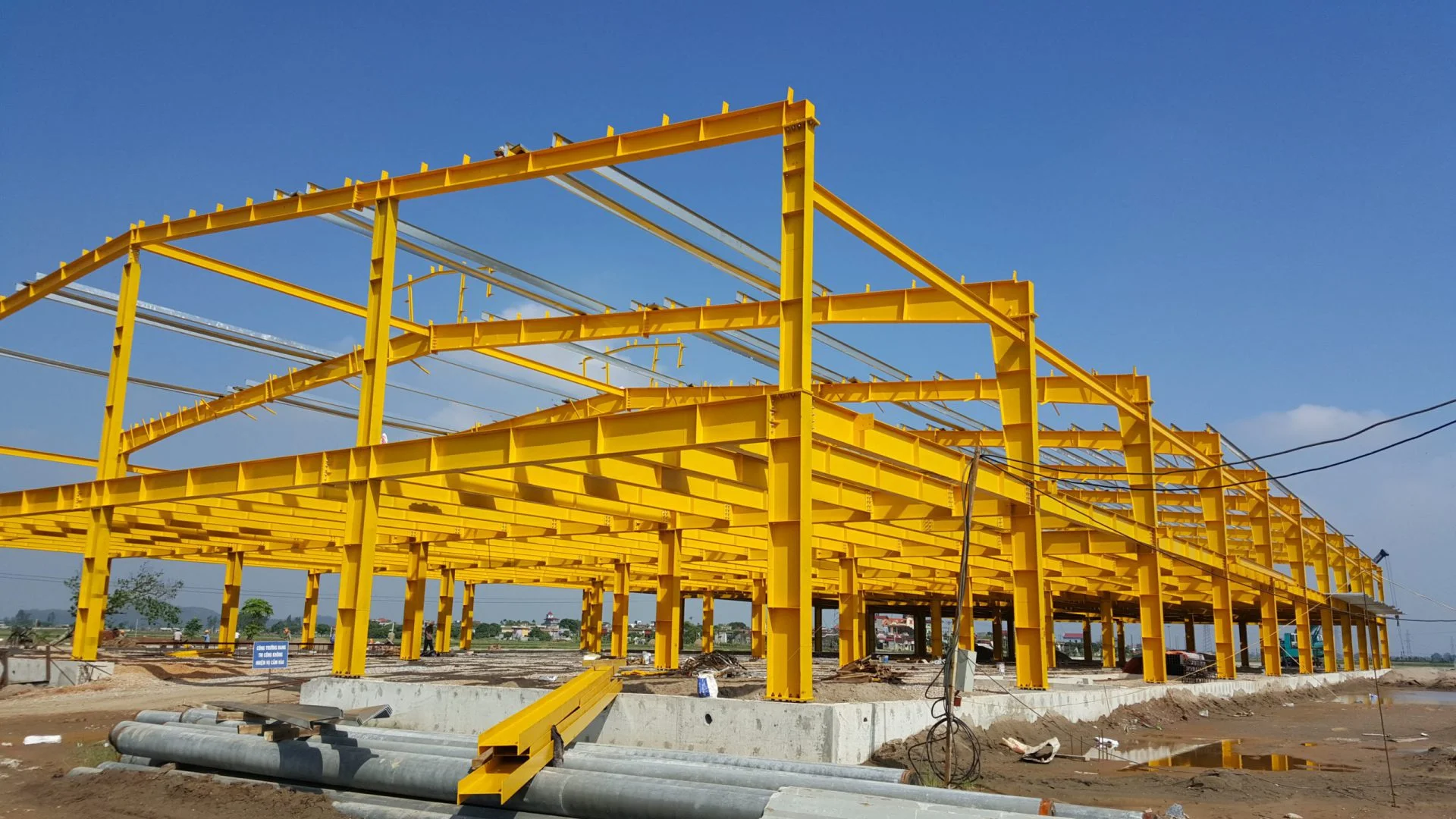
- Erection Sequence: Erection typically begins with the braced bay (the bay with a complete bracing system), then proceeds to the remaining bays. This ensures the stability of the structural system throughout the construction process.
- Bolt Tightening: This is an extremely critical stage. Standards require 100% of structural bolts to be tightened to the design torque. Torque verification must be performed using calibrated torque wrenches and marked upon completion.

Project Acceptance
Acceptance is a continuous process, not just occurring upon project completion. It includes the acceptance of input materials, factory fabrication stages, and on-site erection.
A complete set of acceptance documentation as per regulations must include:
- Design drawings and as-built drawings (recording actual deviations from the design).
- Quality certificates for input materials (steel, bolts, welding rods).
- Professional certificates for welders and high-strength bolt installers.
- Inspection and acceptance reports for weld quality (ultrasonic, magnetic, etc.).
- Acceptance report for protective coating.
- Detailed construction log.
Providing a complete and transparent set of documentation is not only a legal requirement but also a testament to the contractor's professionalism and reputation.
Welding and Surface Protection Technical Standards
Welding and painting are auxiliary processes that directly affect the integrity and lifespan of the steel structure.
Welding Technique
Standards such as TCVN 1691:1975 regulate the basic shape and dimensions of manual arc welds, while TCVN 9391:2012 covers welded steel mesh. The general requirement is that welds must be fully penetrated, free of defects such as cracks, porosity, or undercut, and performed by certified welders. Weld quality is verified using Non-Destructive Testing (NDT) methods such as Visual Testing (VT), Ultrasonic Testing (UT), Magnetic Particle Testing (MT), or Dye Penetrant Testing (PT).

Corrosion Protection (Painting)
Steel structures operating in Vietnam's tropical climate are highly susceptible to corrosion. Therefore, protective painting is extremely important. TCVN 8790:2011 and the TCVN 12705 series are core regulations for this work.
- Paint System: A standard paint system includes a primer (to enhance adhesion and rust resistance), an intermediate coat (to increase thickness and create a barrier), and a topcoat (to resist weather, UV rays, and provide aesthetic color).
- Application Process: Steel surfaces must be cleaned to standard levels (e.g., shot blasting, sandblasting) before painting. The application of paint layers must strictly adhere to the Dry Film Thickness (DFT) and drying times between coats as specified by the paint manufacturer.
- Acceptance: The finished paint layer is inspected for appearance, color, adhesion, and most importantly, the dry film thickness must meet design requirements.